Reading a finding
A finding page is one problem, written to be read top to bottom. The example on this page is a real finding on the Millbrook demo plant: a lift-station pump whose impeller is wearing.
The heading
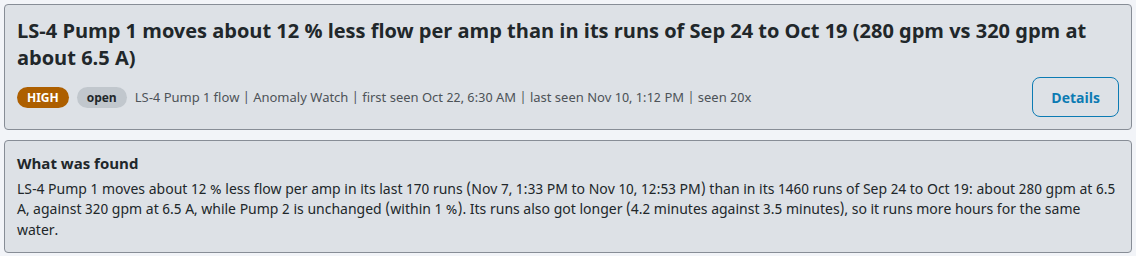
The heading is the finding in one line: "LS-4 Pump 1 moves about 12 % less flow per amp than in its runs of Sep 24 to Oct 19 (280 gpm vs 320 gpm at about 6.5 A)". Under it:
- Severity and status.
- The reading it is about (LS-4 Pump 1 flow) and the check that found it (Anomaly Watch).
- First seen: when Artekis first found it. Last seen: the most recent check that confirmed it. Seen: how many checks have found it.
What was found says the same thing in a few sentences, with the numbers and the dates compared.
The evidence
Under The evidence come the proofs, every one shown at once, most telling first. Each is labeled Proof 1 of 4, Proof 2 of 4 and so on, says what it is, and names the check it came from.
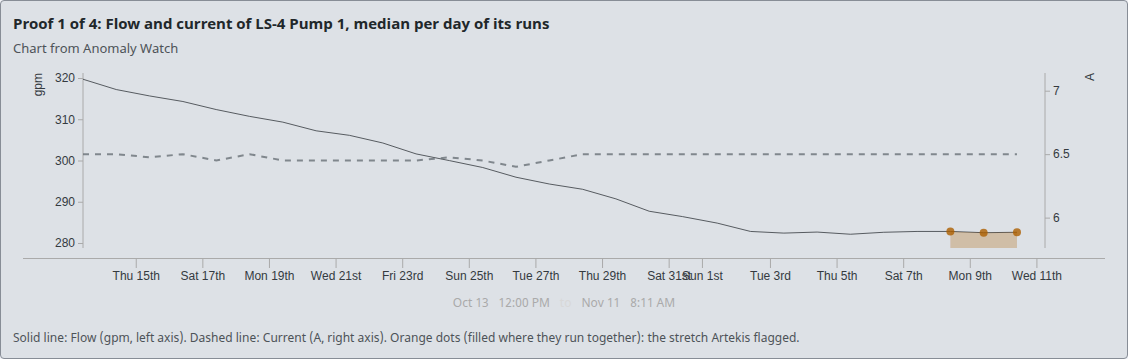
How to read a chart:
- Solid line: the reading the finding is about.
- Dashed line: what it is compared with. The caption under the chart names each line. Here the solid line is the pump's flow and the dashed line is its motor current, on its own axis on the right.
- Dashed lines at the edges: a reading's normal range or its limits, when it has them.
- Orange dots, filled where they run together: the stretch this finding is about.
- The axis title gives the unit (gpm, A, °F, ms).
In this example the flow slides from about 320 to 280 gpm while the current stays flat at 6.5 A. The pump draws the same power and moves less water, which is what a worn impeller does.
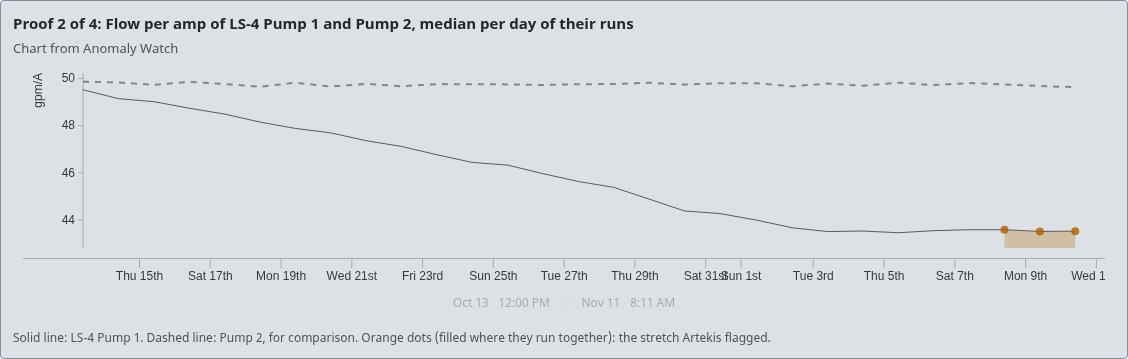
The second proof compares the pump with its twin at the same station. Pump 2 holds flat, so the cause is this pump, not the pipe, the meter or the wet well.
Tables list the records behind a finding, here each recent run with its start, length, flow, current and flow per amp. The last proof is usually the figures the check measured.
Why it matters, what to do now, how to prevent it
Below the evidence:
- Why it matters: the effect on production, cost, safety or equipment life.
- What to do now: the first concrete step, for example "inspect the impeller and wear ring at the next planned stop".
- Cost: the figure and how it was worked out, or why it could not be priced.
- How to prevent it: what would stop it coming back.
- Proposed change, when the finding suggests one (for example a new alarm rule), with what else it would affect.
Artekis only recommends. Nothing on this page changes the plant.
Feedback and questions
At the bottom, record whether the finding is real: Giving feedback. To ask a follow-up question about this problem, press Ask about this: Asking questions.
The page refreshes on its own every minute and whenever a new check finishes.